The Social Work Leadership Award honors a mid-career alum who has demonstrated exceptional leadership in the social work profession.
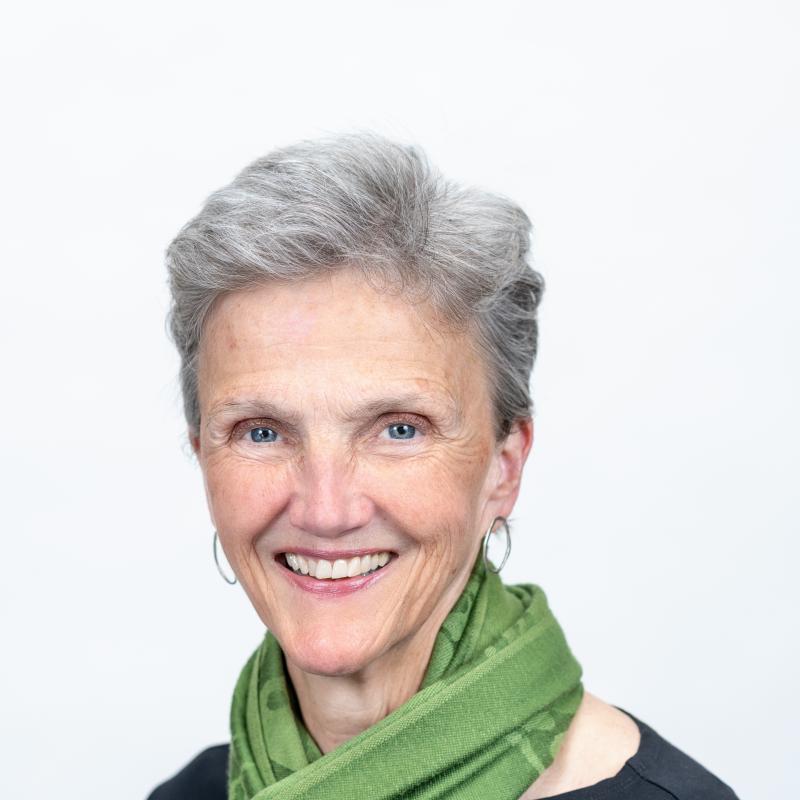
It’s not surprising that her fellow alums chose Cathleen Morey, M.S.W. ’00, Ph.D. ’19, to be this year’s recipient of the Social Work Leadership Award. She has amply met the award’s requirement of having “demonstrated exceptional leadership in the social work profession.”
And in a time when certain prominent leaders are, to quote Shakespeare, “full of sound and fury, signifying nothing,” Morey’s leadership style is exceptional for being, as she described it, “quiet.” After a moment, she elaborated: “My way of promoting the profession, it’s about doing the work, working on the ground, focusing on infrastructure, effecting change over the long run.”
She knows something about the long run: She was awarded her Ph.D. at age 59 and has worked at the renowned Austen Riggs Center in Stockbridge, Massachusetts for 21 years.

“I thought I’d go to Riggs for a couple of years,” she remembered, but the center proved to be just too good a fit. In 2013, she became its director of clinical social work. Among the things she values about Riggs are its deep commitment to education, its emphasis on intersectionality, its sociocultural values, and its systems-based and psychodynamic orientation.
The psychiatric residential facility approaches treatment in a “deep, nuanced way,” she said. For example, “The patient family-history assessment gathers information on three generations, toward understanding the context of a person’s struggles.” This approach speaks to Morey’s own interest in intergenerational family dynamics, one of several subjects she has published papers about.
As her list of publications reveals, an ongoing area of investigation has been how clinical systems work—or don’t. Her research has shown that when a patient with multiple comorbidities and a complicated history isn’t getting better, the treatment team may say the patient is the problem. But the team may be part of the problem, their own histories unconsciously influencing their behavior and the patient’s. Institutional stresses—staff shortages, financial pressures—may come into play. The result of this perfect storm is a system enactment. Morey’s goal in studying that phenomenon is not just to describe it but also to delineate solid, evidence-based means—skills, knowledge, steps—to repair and restore broken-down systems.
“In a system, we all contribute. The scientist in me wants to approach problems with clarity and propose usable solutions. I want to show how social work leadership AWARD to apply new, positive approaches, to create a supportive framework for both patients and staff, a therapeutic culture.”
More recently, Morey has delved into how the ethics of social work are taught.

“I began by looking at the scholarship,” she said. “Much traditional ethics training and education seemed focused on procedure and compliance. It didn’t take into account how power dynamics, privilege, oppression, and racism affect contemporary multicultural practice, and it didn’t address ethical issues clinicians I was teaching were grappling with.
“What I find exciting,” added Morey, “and what people respond to, is reconceptualizing ethical practice, moving beyond a regulatory focus, developing a deeper knowledge, and encouraging aspirational ethics, that is, being accountable to the values of our profession: justice, dignity, integrity, commitment to anti-oppression.”
Her research has led to her giving ethics-related seminars through SSW’s Advanced Clinical Supervision program and Austen Riggs’s Erikson Institute for Education, Research, and Advocacy. Last fall, she was an invited guest speaker at a day-long ethics training for school social workers in Portland, Maine. In April, as an invited guest speaker, she presented “Ethical Dilemmas in Clinical Social Work Supervision” at the American Board of Clinical Social Work’s annual conference.
Morey sees herself as part of an “intergenerational legacy.” Mentored at Smith by leaders in the profession such as Kathryn Basham and Joanne Corbin, she seeks to do the same in her role as an SSW adjunct assistant professor and professional education instructor. And several years ago, she was instrumental in establishing internships at Austen Riggs for students from Smith and other social work programs.

With her Austen Riggs position, her teaching, presenting, and publishing, Morey might be excused for thinking she was doing enough to “elevate social work practice,” a lifetime goal. Not so. Since 2020, she has volunteered with the nonprofit International Social Work Solutions, developing and consulting on programs for NGOs operating in the Democratic Republic of Congo and Uganda. Last year, she designed and co-led a trauma-training conference in Ghana for young women who had been subject to ritual servitude and sex trafficking.
In describing that intense experience, Morey praised her co-leader’s contribution at length. About her own, her quiet leadership style showed itself as she said simply, humbly: “I was honored that the participants let me into their lives.” ◆