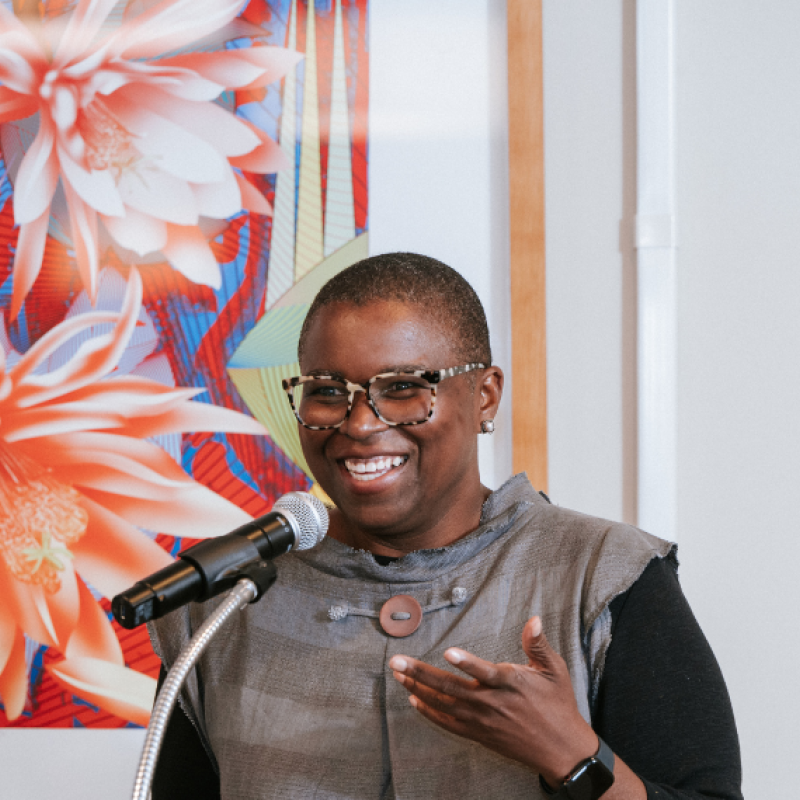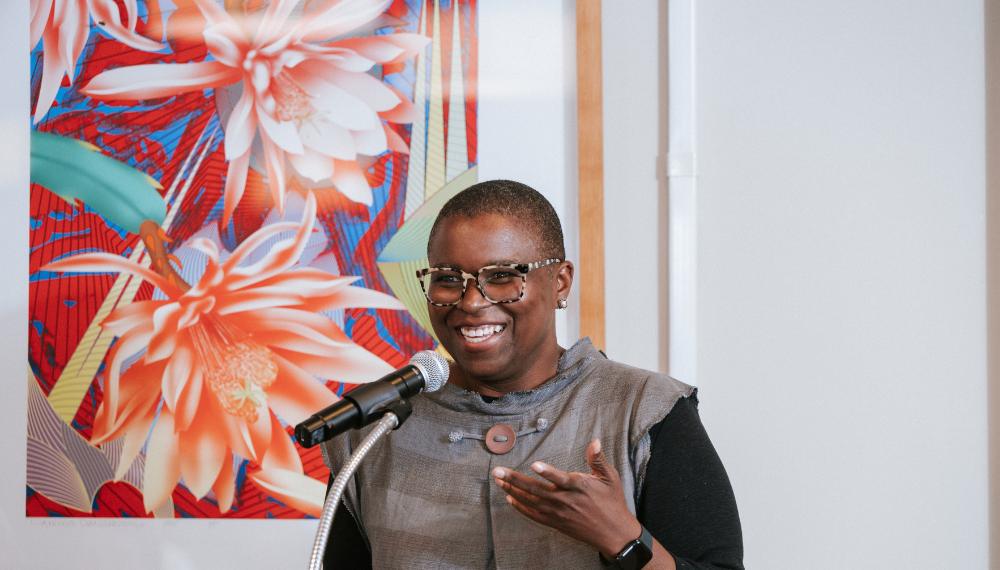
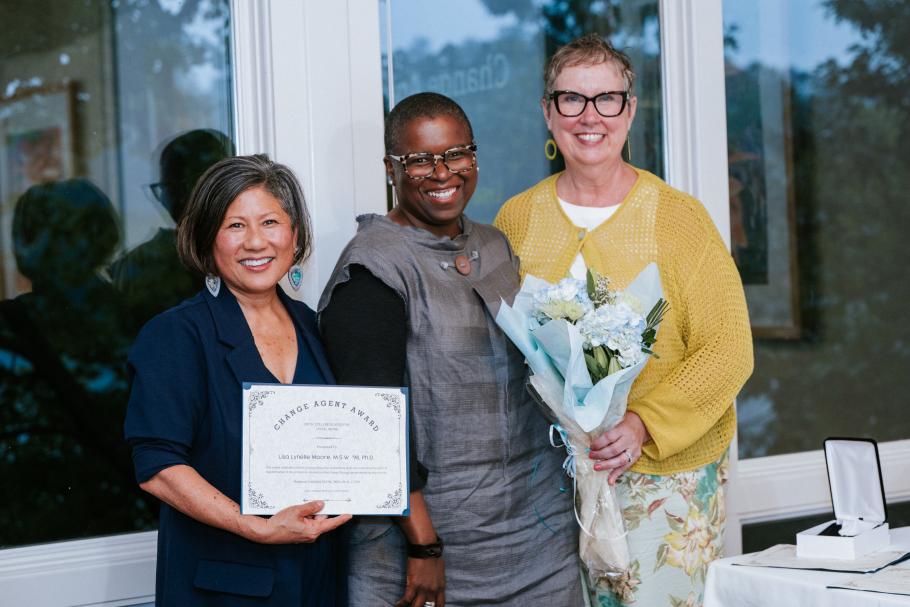
Lisa Lynelle Moore, M.S.W. ’98 is the 2025 recipient of the Change Agent Award, which honors a School for Social Work alum “who embodies the spirit of transformation in the profession, driving positive change through groundbreaking approaches.”
Asked why she thought her fellow alums might see her as a change agent—put on the spot, in other words— Moore pointed to her teaching. Having previously taught at Boston University and St. Olaf College, she is now a senior lecturer and the director of the master’s program in Social Work, Social Policy, and Social Service Administration at The Crown Family School of Social Work, Policy, and Practice at the University of Chicago, where she also serves as a faculty resident head. She has previously served as assistant dean for multicultural affairs at Reed College, assistant director for the Women’s Community Center at Stanford University and as director of the Mary McLeod Bethune Multicultural Center at Clark University. In these administrative positions, each one new to the institutions, she was responsible for building infrastructures for supporting students, staff, and junior faculty from historically underrepresented populations.
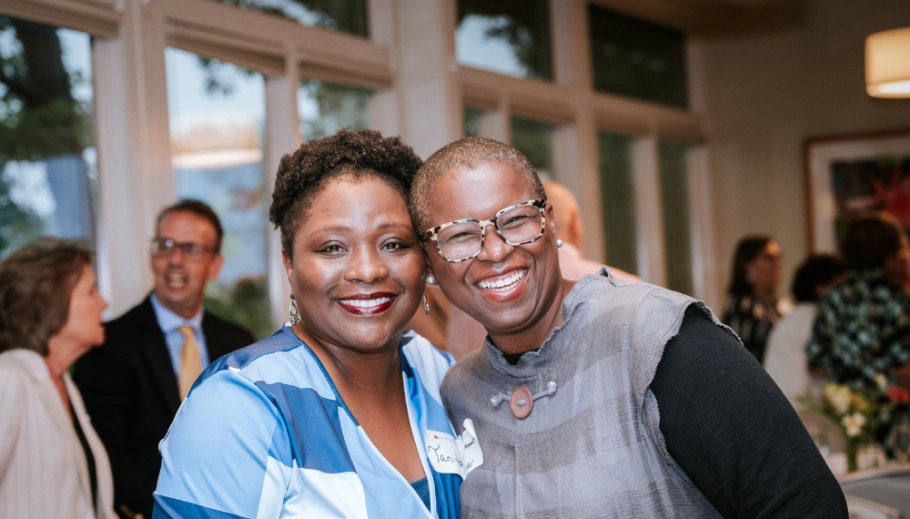
“I’ve been in higher education for 26 years, as a student, an administrator, adjunct faculty, tenured professor,” Moore noted, adding almost shyly, “I think I’m a pretty good teacher.” Then her face lit up as she talked about how exciting teaching, working with, and mentoring students has been and still is to her. She spoke enthusiastically about the “creative, amazing things” former students are doing and about the career of a “brilliant” former student she was about to visit in Massachusetts.
As evidence of her change agent status, Moore might also have cited her impressive, innovative research. Having studied political science as an undergrad and social and cultural anthropology for her doctorate, she brings an interdisciplinary perspective to investigating where the personal and the institutional converge and how concepts drawn from psychology, Black feminism, and philosophy can be combined to create a broader, more relevant understanding of how trauma affects individuals, families, and generations of families. “Taking psychodynamic theory beyond the individual, uncovering the relationships between the individual and systems and institutions— which is what social work is about—is really important to me,” she noted.
In conversation, Moore reveals her wide-ranging intellect, referring to the poetry of Smith College professor Yona Harvey and the teachings of Buddhist nun and author Pema Chödrön. She names Jean Baker Miller, originator of relational theory, as a key influence and, has been, in her words, “obsessed” recently, by the work of British social worker Foluke Taylor, whose work takes a self-reflexive look at the genealogy of psychodynamic/ psychoanalytic therapeutic practices through a Black feminist lens.
She has built some of her recent talks around the work of Franz Fanon, the revolutionary French Martinican anti-colonial philosopher and psychiatrist. His concept of phobogenesis (fear of the Black body) captures the processes of dehumanization of Black bodies and offers language for identifying and addressing it in psychoanalytic theory and practice.
While Moore is obviously drawn to thinkers who push conceptual boundaries, she is modest about her own status as someone who does just that. “I like being in the background, not being the center of attention,” she said.
Yet when she is the center of attention, she is illuminating. “Mourning Walk,” a Zoom presentation she gave in 2021 is thought-provoking and moving. (Hosted by the University of Minnesota’s Center for Practice Transformation, it’s available online.) In it she talks about such heady subjects as relational cultural theory, autoethnography, and epigenetics— and her own family’s traumatic history, including her uncle’s murder by white supremacists in 1958. At one point, she conveys what it’s like to be a person of color in a racist environment with this vivid analogy: “Imagine traveling someplace where you don’t speak the language, you don’t look like the people there…and imagine living in that space and never being able to leave.”

It’s been somewhat surprising but gratifying, Moore said, that she has been invited to speak about her work expanding the dimensions of psychodynamic theory by such organizations as the Manhattan Institute of Psychoanalysis, the American Association of Psychoanalysis in Clinical Social Work, and the New England Center for Existential Therapy. Last August, she was the keynote speaker at SSW’s Deepening Clinical Practice Conference. Her topic: “Complementary Trauma: Exploring the Uncertainty of Relational Dynamics from the Interpersonal to the Institutional.”
Moore was surprised to be given the Change Agent Award, she said, but it’s pretty clear from her teaching, research, and presentations (and “Lisa Lynelle’s Newsletter” on Substack) that she is all about evolving, extending, and upending ideas, empowering people, and changing things for the better. ◆