
Info For: Faculty and Staff
We are so excited to welcome you (back) to SSW. We've compiled checklists, forms, schedules, and helpful websites here. This site is updated regularly, please check back for new information in the coming months. If you have any questions, please contact us. We’re happy to help!
Contact Faculty Support Services
Lilly Hall
23 West Street
Northampton, MA 01063
Email: sswfacultysupport@smith.edu
Phone: 413-585-7978
Our Five Core Principles
Our School is committed to five Core Principles of racial justice that guide all areas of our programs and work as we constantly strive towards greater anti-racism – an ongoing goal to which the entire School community aspires.
Handbooks, Guides and Resources




“Art allows me to be creative outside the canon. Someone who’s not going to read my 300-page Ph.D. dissertation or my scholarly writings—the currency of academia—will attend an art exhibition. Art can make ideas accessible and available to a wider range of people; it provides an entry site. It’s a way of inviting people in.”
Loren Cahill, M.S.W., Ph.D.
Assistant Professor
Policies and Practices
Registrar's Office
Clinical social work practice is concerned with the interdependence between individuals and their environments and the use of theoretically-grounded, relationship-based, culturally-informed interventions to promote healing, growth and empowerment. Clinical social work recognizes and responds to the complexities of the human condition: its strengths, possibilities, systems of meaning, resilience, vulnerabilities and tragedies. As a collaborative process, clinical social work expresses the core values of the profession, including recognition of client self-determination, growth and change in the client system and pursuit of social justice. It rests upon a liberal arts base and integrates evolving theories about individuals, families, groups, communities and the larger social systems in which they are embedded.
In its educational practices, the School promotes critical thinking and self-reflection to help students expand their knowledge in the substantive areas of human behavior and the social environment, social work practice, research, social policy, internships, values and ethics, diversity, populations-at-risk and social and economic justice. The School educates students in the application of professional values and ethics, collaboration with other disciplines and the evaluation and dissemination of evolving theories and practice models.
The School shares with the social work profession its historic commitment to serve oppressed, disadvantaged and at-risk members of our society. It is committed to implementing a curriculum that addresses the concerns, issues and interests of these populations. The School joins with the profession to struggle against inequity and oppression based on such variables as: race, ethnicity, class, gender, sexual orientation, religion, age and disability. The School and Smith College are committed to social justice, service to society and appreciation of individual and cultural diversity in a multicultural community. The School recognizes the pernicious consequences of racism and works to identify and diminish the overt and covert aspects of racism. Smith College School for Social Work is committed to work toward becoming an anti-racist institution through its five Core Principles among other community-driven work.
The School implements its educational mission through its master’s and doctoral degree programs. Through its scholarship, publications, research and program initiatives, the School contributes to the development and dissemination of knowledge relevant to social work. In its affiliation with a liberal arts college, the School places a priority on the process of teaching and learning and community service. The School maintains relationships of mutual respect and influence with its affiliated agencies, major professional organizations and other representatives of the social work practice community to aid in curriculum renewal and to contribute to the development of the profession as a whole.
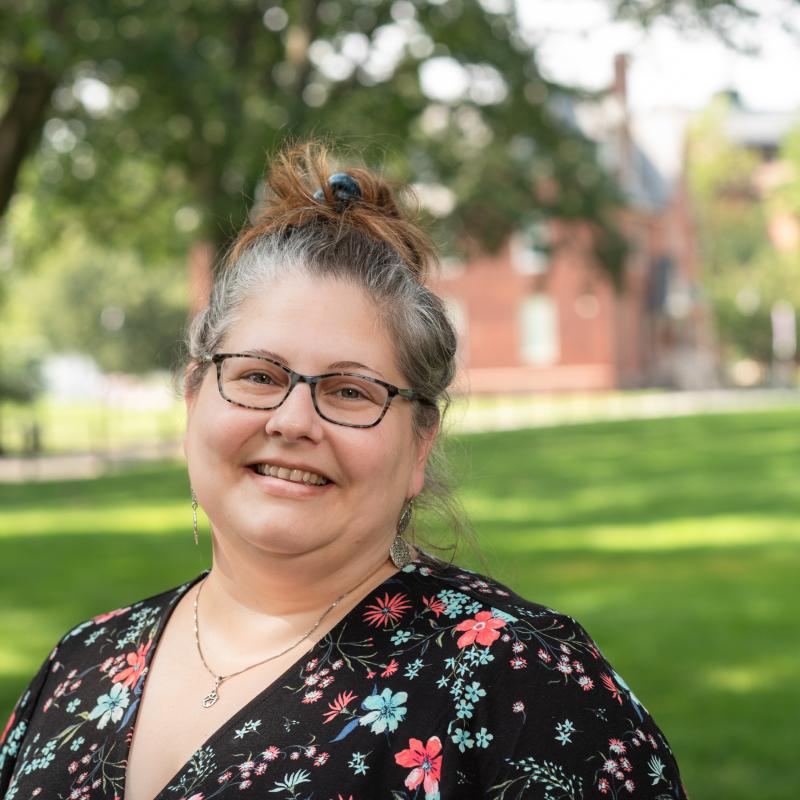
"We have the advantage of the bigger campus and the resources of that, but we’re still our own little community at SSW. You feel like you belong."
Marybeth Stratton
Systems Manager, Practicum Learning
Meet Our Faculty & Staff